


Self-guided bike tours let you cycle through Italy at your own pace, without a group and without a guide, on a route that someone local has already planned for you.
Your hotels are booked, your luggage is moved every morning and the route is on your phone or on a GPS device, which many operators rent out. You just ride.
On paper, most self-guided tours look the same. In practice they are not: the difference is made by the tour operator behind the trip, and you only find out when something does not go to plan.
This guide explains how a self-guided tour works, what a good one looks like, and how to check the operator before you book.
What is a self-guided bike tour?
It is a multi-day cycling holiday, usually five to eight days, where someone else handles the logistics and you do the riding: alone, as a couple or with your own friends.
You choose when to leave in the morning, where to stop for coffee and how long to stay in the village square.
Self-guided does not mean unsupported, though. A well-run self-guided tour is a trip where you travel independently and still have someone behind you, before you leave and every day on the road.
How it works, step by step
- Before you leave. You choose a tour and your dates; the operator books the accommodation along the route and sends you the GPS tracks and the roadbook.
- Arrival. You reach the starting town on your own, usually by train. If you rent a bike, it is fitted to you there.
- The briefing. Before the first day someone walks you through the route, stage by stage, and makes sure the navigation works on your phone or GPS device.
- Every morning. You leave your bags at reception and ride. Your luggage travels to the next hotel and is waiting for you when you arrive.
- On the road. You follow the route in an app on your phone or on your GPS device, with notes on what to see, where to stop and where to refill your bottles.
- If something goes wrong. A wrong turn, a closed road, a question about dinner: you call the operator.
- The last day. You arrive at the finish; a rented bike is collected there.
What makes the difference: the operator behind it
Two self-guided tours on the same roads can be two very different holidays. In the weakest version you receive a set of GPS tracks and a list of hotels, and that is it.
In a good one the operator is present even when you cannot see them. This is what to look for.
- A personal briefing. Not a PDF: a conversation, in person or on a call, where someone helps you load the tracks onto your GPS device, installs the app with you, explains how it works and goes through the route stage by stage.
- A detailed roadbook. Everything said in the briefing stays with you, well organised: maps, a description of each stage, what to see, where to eat. It is what you open in the evening to plan the next day.
- Live support on the route. If a road is closed or a stretch has become unrideable, a good operator can change the track from the office, while you are on the road, and send the new route straight to your app.
- Routes that are ridden every year. Roads change: a gravel section washes out, a bridge closes, a café shuts down. The routes should be checked in person, by bike, every season, not drawn once on a map and sold for years.
- Experiences you could not book on your own. The point of travelling slowly is to see the Italy between the famous towns. Even without a guide, the operator can arrange the things that make a trip: sitting down with a beekeeper, an olive oil tasting at a farm, a winery visit in a village that is not in any guidebook.
When two offers differ in price, this is usually where the difference is. It is worth asking about before you compare the numbers.
How to check a tour operator before you book
You do not have to take anyone's word for it. A few checks take less than an hour.
- Talk to them first. Some operators offer a free consultation before you book, to help you choose the right route for your level and your dates. It is the quickest way to test the service: how fast they answer, how well they know their routes, whether they ask about you or just send a price.
- Read the reviews, and read the negative ones: what went wrong, and how the operator handled it.
- Check the licence and how your money is protected. In the EU, anyone selling a package holiday must protect your money if the company goes out of business. In Italy, tour operators must also be registered with the local authorities and carry professional liability insurance. A legitimate operator will give you the details.
- Look for independent coverage. Articles about the operator in credible publications, or recommendations from cycling clubs and travel forums, are a good sign.
- Ask a few direct questions. Who answers the phone during the trip, and in what language? When were the routes last ridden? What happens, and what does it cost, if I have a mechanical problem?
One thing you need to do yourself: learn to fix a puncture
Support on a self-guided tour is mostly by phone. For small mechanical problems, a puncture above all, you are expected to sort it out yourself: sending someone out to you usually has a cost, and on a quiet country road it can take a while.
So before you leave, practise. Change an inner tube at home a couple of times, watch a few videos or join a basic maintenance workshop at a local bike shop.
It takes an afternoon, and it turns a puncture from a problem into a ten-minute stop.
Guided or self-guided?
With a tour operator there are two ways to cycle through Italy, and it helps to see them side by side. Riding fully unsupported, planning the route and booking everything yourself, is a different kind of trip altogether.
| Guided | Self-guided | |
|---|---|---|
| Route planned for you | Yes | Yes |
| Accommodation booked | Yes | Yes |
| Luggage transferred | Yes | Yes |
| Guide riding with you | Yes, usually with a support vehicle | No |
| Group | Organised group | You and who you choose |
| Pace and stops | Shared with the group | Yours |
| Help on the road | The guide is there | By phone |
Choose guided if you want someone to handle everything, including the unexpected, and you enjoy riding in a group.
Choose self-guided if you value your own pace and your own company, and you are happy to follow a route on your phone and fix a puncture.
Is a self-guided tour right for you?
- Fitness. Check the daily distance and climbing, not just the label. As a rough guide, an easy tour means 40–55 km (25–35 miles) a day on gentler terrain; an intermediate one means 50–90 km (30–56 miles) with real hills, sometimes more than 1,200 m (3,900 ft) of climbing in a day. On an e-bike, both feel a lot easier.
- E-bikes. Many self-guided tours can be ridden on an e-bike, and most operators rent them. It is the simplest way to enjoy the hills of central Italy if you do not ride regularly at home.
- Navigation. You need to be comfortable following a route on your phone or a GPS device. You do not need to be good with maps: the track does the work.
- Travelling solo. Self-guided tours work for one person, a couple or a group of friends. There are no pre-formed groups.
What is usually included, and what is not
Most self-guided tours include accommodation with breakfast, the GPS tracks and roadbook, the luggage transfer between stages and assistance by phone.
Usually not included, and worth checking before you compare offers: lunches and dinners, bike rental, local tourist taxes, travel insurance, and getting to the start and home from the finish. Tastings and experiences along the way are normally optional and booked on request.
Where to go on a self-guided cycling holiday in Italy
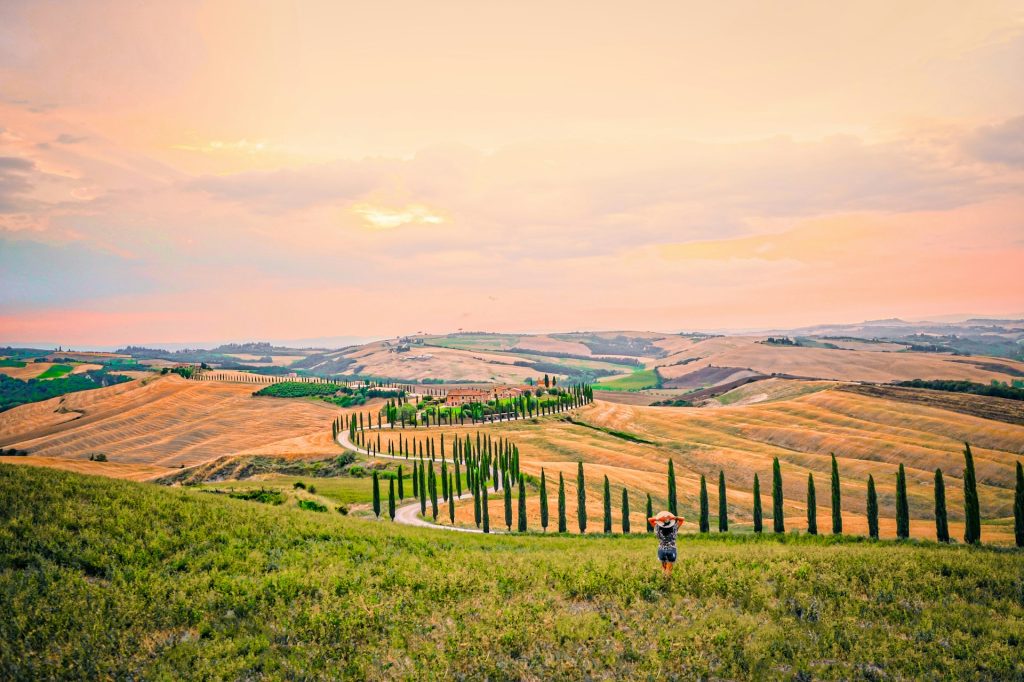
Most people start with the famous names: Tuscany and the Chianti, the Dolomites, Puglia, Sicily, Lake Garda. They are famous for good reasons, and in high season they are also the busiest.
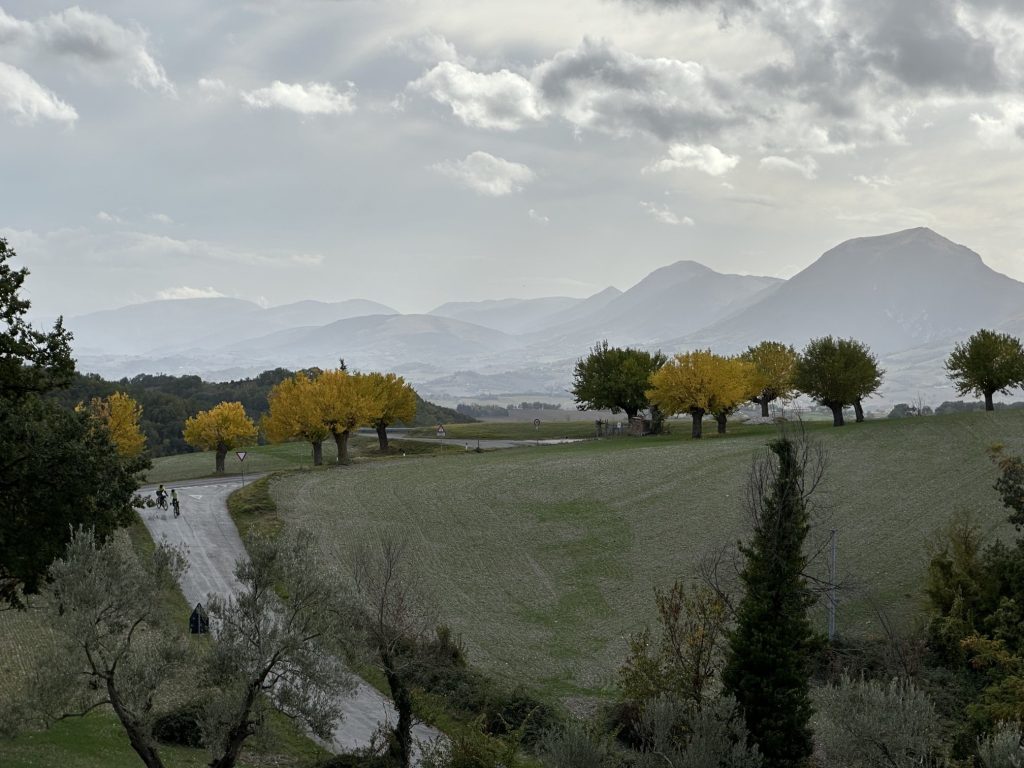
If you want the same hill towns, food and wine with quieter roads and far fewer tour buses, look at central Italy, between the Adriatic and the Tyrrhenian Sea: the Marche, Umbria and southern Tuscany, crossed by strade bianche, the white gravel roads of the Italian countryside.
When to go
Spring and early autumn are the best seasons for cycling in central Italy: mild temperatures, green hills in spring and the grape harvest in September and October.
In July and August the inland areas, especially southern Tuscany, can be very hot, and starting early becomes essential.
How we run our self-guided tours
We are Basecamp523, a small cycling tour operator based in Fabriano, in the heart of Italy.
For us a self-guided tour works only if you travel on your own but are never left on your own. So here are our answers to the checks above.
- Can we talk before you book? Yes: the consultation is free, and it is how we find the route that fits you.
- Who answers the phone during the trip? We do. Our assistance is available 24 hours a day.
- Are we licensed, and is your money protected? We are a registered tour operator (SCIA no. 33277/2021, Municipality of Fabriano), insured for professional liability with Unipol (policy no. 193839071), and payments are protected against insolvency by the TOP Secure guarantee fund.
- When were the routes last ridden? This year, like every year: we ride them ourselves to check that everything is as it should be.
- What happens before the first day? A personal briefing: we load the tracks onto your GPS, install the app with you and go through every stage. You leave with a detailed roadbook, a power bank to keep your phone charged and, if you want one, a rented GPS device.
- And on the road? If something changes, we update your route live in the app from our office. On request we also book local experiences, from an afternoon with a beekeeper to an olive oil tasting.
You can read more about who we are and what has been written about us.
These are our self-guided tours:
| Tour | Days | Distance | Level |
|---|---|---|---|
| Italy Coast to Coast (Marche, Umbria, Tuscany) | 8, 7 riding | 496 km (308 mi) | Intermediate |
| Umbria: diamond cities and hidden villages | 8, 6 riding | 298 km (185 mi) | Easy |
| Parks and Borghi (Marche) | 7, 5 riding | 135–255 km (83–160 mi), with daily route options | Easy |
| Luxury Bike Tour between Marche and Romagna | 5, 3 riding | 150 km (93 mi) | Intermediate |
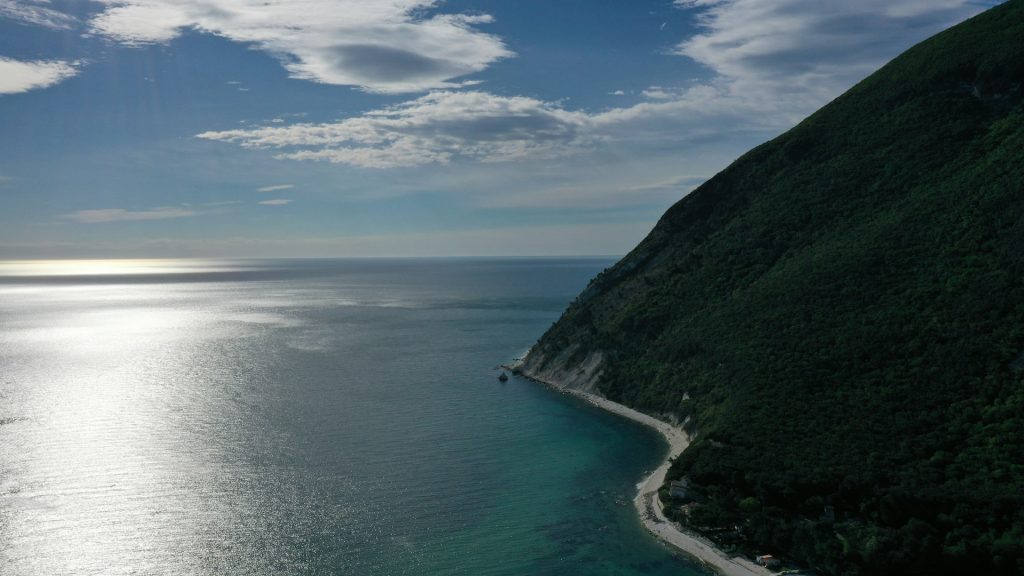
The Coast to Coast is the one we are proudest of: 496 km (308 miles) in seven riding days from the Conero Riviera on the Adriatic to the Argentario on the Tyrrhenian, mostly on quiet back roads and gravel.
It crosses some of Italy's great wine country (Verdicchio, Sagrantino, Vino Nobile di Montepulciano, Brunello di Montalcino, Morellino di Scansano), Assisi, the Val d'Orcia and the Maremma.
FAQ
Can you tour Italy by bike on your own?
Yes. That is exactly what a self-guided tour is: you ride on your own, with the route, the hotels and the luggage organised for you, and a tour operator to call if you need help.
Do I need my own bike?
No. You can bring yours or rent one locally, gravel or e-bike; a rented bike is fitted to you on arrival and collected at the finish.
What happens if I get a puncture?
You fix it yourself, which is why it is worth practising before you leave. For anything bigger you call the operator; sending a mechanic to you usually has a cost.
How do I know if a self-guided tour operator is reliable?
Talk to them before booking, read their reviews, check that they are a licensed tour operator and ask how often their routes are ridden and checked.
How much does a self-guided bike tour in Italy cost?
It depends on the number of days, the level of the hotels, the season and whether you rent a bike. Compare what is included, not just the price: each of our tour pages shows the price and exactly what it covers.
How many days do I need?
Most self-guided tours last about a week. Ours run from 5 to 8 days, with 3 to 7 days in the saddle.
What is the best self-guided bike tour in Italy?
It depends on what you are after. For the classic postcard, Tuscany; for mountains, the Dolomites; for quiet roads, wine and hill towns without the crowds, central Italy: Umbria and the Marche.
Plan your self-guided tour
Have a look at our self-guided Coast to Coast and the other tours above: each page has the day-by-day programme, the dates and what is included.
If you would like help choosing, write to us for a free consultation and we will suggest the tour that fits you best.